
AGRICULTURE
in balance
AGRICULTURE
in balance
BACKGROUND
The global loss of biodiversity has widely been identified among the most pressing challenges to humanity for the coming decades. Current extinction rates for mammals and other taxa are higher than would be expected from the fossil records, highlighting the need for effective conservation measures.
One of these mammals on the verge of extinction is the Common hamster (Cricetus cricetus). The range of the species is currently very fragmented with population decreases by more than 75% throughout Western and Eastern Europe. In 2008 a Standing Committee of the Bern Convention stated that the hamster must be prevented from extinction in Germany, France, Belgium and The Netherlands.
The improvement of this conservation status is obliged through the Habitats Directive for EU Member States. Currently the Species Protection Programmes in the Western part of Europe fail to reach this objective due to a lack of knowledge, innovation, and allocation of financial resources.
To protect this mammal from extinction in Belgium, The Netherlands and Germany (North Rhine-Westphalia), and to avoid a million claim by the EU, the project LIFE Cricetus has been set up and approved by the EU Commission. The project runs from September 2025 until March 2032.
PROJECT GOALS
Objective and Context
This project aims to apply an integrated management system for the protection of this endangered species. Since the hamster inhabits agricultural ecosystems, sustainable protection of their habitat and enhancement of its quality is necessary. The fact that the species inhabits rural landscapes owned and managed by private farmers indicates that the implementation of suitable measures for the hamster depends on the farmers’ willingness to collaborate.
Approach
By setting up sustainable hamster cooperations with farmers the project aims to implement several innovative techniques to enhance the economic valorisation of the crops, the conservation status of the Common hamster and overall biodiversity through innovative species and agricultural approaches and techniques. This should result in a competitive sustainable income for farmers combined with protecting and enhancing population densities of the Common hamster.
Impact and Policy Integration
This project will accelerate and enhance the implementation of Species Protection Programs in the three regions (Belgium, the Netherlands, and Germany/NRW) by providing new insights and initiating actions tailored to meet the biological needs of the hamster. By preparing policybriefs and integrating the new techniques into the new Common Agricultural Policy, support is given to a science- based policy and a sustainable future for the hamster and farmer. The approach and used techniques within this LIFE Cricetus project will act demonstrative to other EU regions where the hamster is declining.
OBJECTIVES

Prevent Regional Extinction
Prevent the extinction of Cricetus cricetus in the BNN-region This objective will be supported by increasing their population density through strategic introductions and the implementation of innovative agricultural practices, which are designed to enhance reproductive success. This will result in an increase in both the number and size of litters during the breeding season in wild populations.
Secure Long-Term Survival
Long term survival and fitness of the Common hamster by the development and implementation of innovative crop management and corridors which will also enhance overall biodiversity (soil biodiversity, farmland birds and pollinators), reduce erosion and contribute to climate adaptation. The survival and density of the hamster and other protected farmland species will be enhanced while providing the farmers with an economic output.
Establish Experimental & Demonstration Farms
Establishment of experimental and demonstration farms where the feasibility and effectiveness of new agricultural management measures, designed to integrate the needs of Cricetus cricetus, farmland wildlife and the farmer, will be assessed and reconciled with intensive agricultural systems which are situated outside of protected conservation areas.
Build Hamster Cooperatives
Establishment of agricultural hamster cooperatives that support the protection of the hamster and contribute to a sustainable future for this species, as well as other farmland biodiversity.
Expand Managed Habitat Area
Increase the area of land managed to protect the hamster and other agricultural wildlife in intensive farmland through hamster-friendly measures & participatory, inclusive agricultural and landscape planning.
Strengthen Science-Based Policy
Contributing to a science-based policy by formulating advice and implementation of new measures for the Common hamster.
Raise Awareness & Support
Raise awareness and enhance the support for the hamster and biodiversity-friendly agricultural management within local communities and specific stakeholders as farmers, policymakers, citizens and scientists.
Transfer Knowledge Across Europe
Dissemination of the findings, actions, and management structure, to other areas where other European genetic lineages of Common hamster are present and declining.
Project area
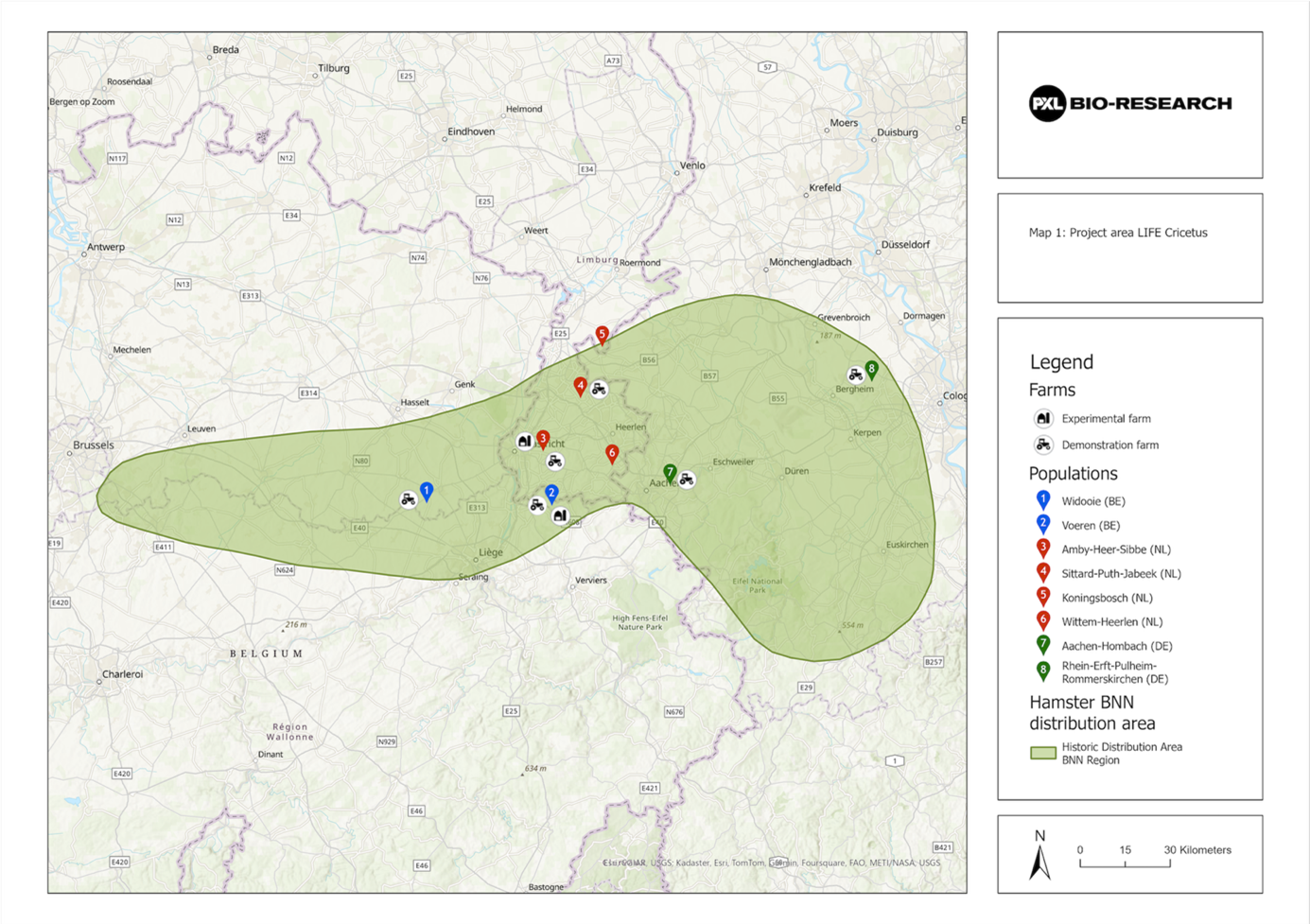
In this project the region of the BNN genetic lineage of the Common hamster is used to demonstrate this integrated approach. The BNN-region comprehends the South of Limburg (BE), Limburg (NL) and the state of North Rhine-Westphalia (DE/NRW).
Click the image to expand
BACKGROUND
The global loss of biodiversity has widely been identified among the most pressing challenges to humanity for the coming decades. Current extinction rates for mammals and other taxa are higher than would be expected from the fossil records, highlighting the need for effective conservation measures.
One of these mammals on the verge of extinction is the Common hamster (Cricetus cricetus). The range of the species is currently very fragmented with population decreases by more than 75% throughout Western and Eastern Europe. In 2008 a Standing Committee of the Bern Convention stated that the hamster must be prevented from extinction in Germany, France, Belgium and The Netherlands.
The improvement of this conservation status is obliged through the Habitats Directive for EU Member States. Currently the Species Protection Programmes in the Western part of Europe fail to reach this objective due to a lack of knowledge, innovation, and allocation of financial resources.
To protect this mammal from extinction in Belgium, The Netherlands and Germany (North Rhine-Westphalia), and to avoid a million claim by the EU, the project LIFE Cricetus has been set up and approved by the EU Commission. The project runs from September 2025 until March 2032.
PROJECT GOALS
Objective and Context
This project aims to apply an integrated management system for the protection of this endangered species. Since the hamster inhabits agricultural ecosystems, sustainable protection of their habitat and enhancement of its quality is necessary. The fact that the species inhabits rural landscapes owned and managed by private farmers indicates that the implementation of suitable measures for the hamster depends on the farmers’ willingness to collaborate.
Approach
By setting up sustainable hamster cooperations with farmers the project aims to implement several innovative techniques to enhance the economic valorisation of the crops, the conservation status of the Common hamster and overall biodiversity through innovative species and agricultural approaches and techniques. This should result in a competitive sustainable income for farmers combined with protecting and enhancing population densities of the Common hamster.
Impact and Policy Integration
This project will accelerate and enhance the implementation of Species Protection Programs in the three regions (Belgium, the Netherlands, and Germany/NRW) by providing new insights and initiating actions tailored to meet the biological needs of the hamster. By preparing policybriefs and integrating the new techniques into the new Common Agricultural Policy, support is given to a science- based policy and a sustainable future for the hamster and farmer. The approach and used techniques within this LIFE Cricetus project will act demonstrative to other EU regions where the hamster is declining.
OBJECTIVES
Prevent Regional Extinction
Prevent the extinction of Cricetus cricetus in the BNN-region This objective will be supported by increasing their population density through strategic introductions and the implementation of innovative agricultural practices, which are designed to enhance reproductive success. This will result in an increase in both the number and size of litters during the breeding season in wild populations.
Secure Long-Term Survival
Long term survival and fitness of the Common hamster by the development and implementation of innovative crop management and corridors which will also enhance overall biodiversity (soil biodiversity, farmland birds and pollinators), reduce erosion and contribute to climate adaptation. The survival and density of the hamster and other protected farmland species will be enhanced while providing the farmers with an economic output.
Establish Experimental & Demonstration Farms
Establishment of experimental and demonstration farms where the feasibility and effectiveness of new agricultural management measures, designed to integrate the needs of Cricetus cricetus, farmland wildlife and the farmer, will be assessed and reconciled with intensive agricultural systems which are situated outside of protected conservation areas.
Build Hamster Cooperatives
Establishment of agricultural hamster cooperatives that support the protection of the hamster and contribute to a sustainable future for this species, as well as other farmland biodiversity.
Expand Managed Habitat Area
Increase the area of land managed to protect the hamster and other agricultural wildlife in intensive farmland through hamster-friendly measures & participatory, inclusive agricultural and landscape planning.
Strengthen Science-Based Policy
Contributing to a science-based policy by formulating advice and implementation of new measures for the Common hamster.
Raise Awareness & Support
Raise awareness and enhance the support for the hamster and biodiversity-friendly agricultural management within local communities and specific stakeholders as farmers, policymakers, citizens and scientists.
Transfer Knowledge Across Europe
Dissemination of the findings, actions, and management structure, to other areas where other European genetic lineages of Common hamster are present and declining.
Project area
In this project the region of the BNN genetic lineage of the Common hamster is used to demonstrate this integrated approach. The BNN-region comprehends the South of Limburg (BE), Limburg (NL) and the state of North Rhine-Westphalia (DE/NRW).
Click the image to expand